Loading
Case studies & project work
Every project here is a documented outcome — the problem, the architecture, and what actually changed as a result.
3 projects total
1 categories
Showing 3 projects
AI Automation
AI Receptionist for Real Estate — Handles Clients on Telegram, 24/7
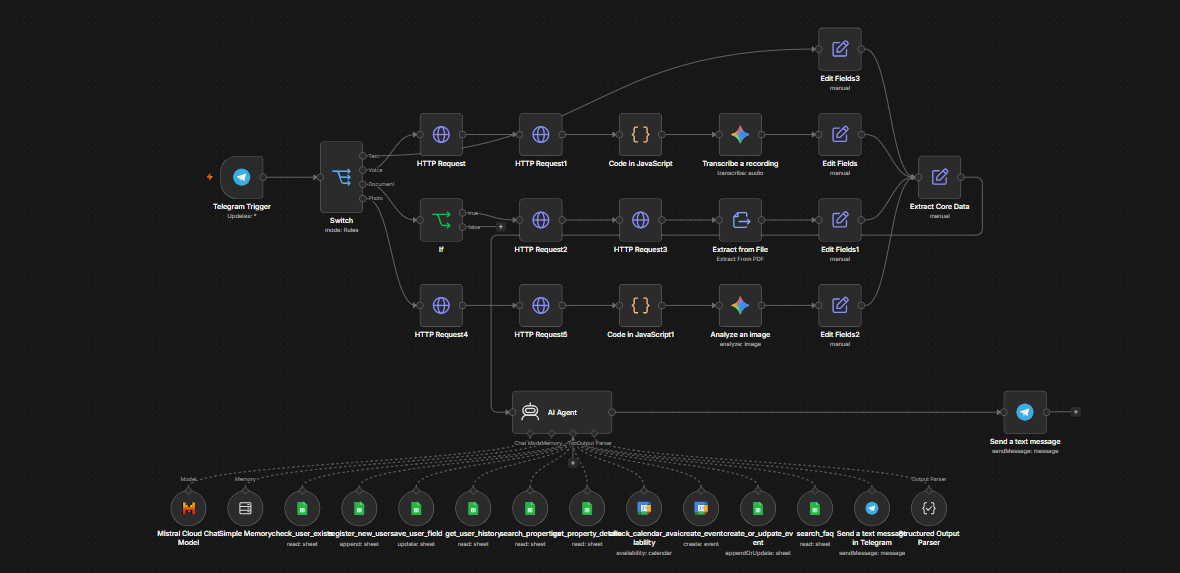
An AI receptionist that chats with real estate clients on Telegram, answers questions, books appointments, and reports every conversation to the owner. ## The Problem Real estate companies deal with clients at all hours. Someone sees a property listing at 10 PM and sends a message. Someone else sends a voice note during lunch. Another person drops a PDF brochure asking "do you have something like this?" A human receptionist can't be available all the time. And when they're busy, clients wait — and waiting in real estate often means losing the deal to someone who replied faster. Beyond availability, there's another problem: after dozens of conversations a day, important client details get forgotten, appointments get missed, and the business owner has no clear picture of what's happening with each client unless they follow up with the team manually. I built an AI receptionist that solves all of this. --- ## How It Works The AI lives inside **Telegram**, which means clients don't need to download anything new — they just send a message like they normally would. What makes this different is that the AI can handle **any type of message**. Text, voice notes, images, videos, PDFs — it reads and understands all of them. If someone sends a voice note, it transcribes it. If someone sends a property document, it reads it. The client never has to worry about format — they just communicate naturally. Once the AI understands the message, it responds using the company's own knowledge base. It knows the properties, the pricing, the company policies, the team — everything the company has put into its database. So the answers it gives are accurate and relevant, not generic. --- ## What It Can Actually Do It's not just a chatbot that answers FAQs. This AI can take real actions. If a client wants to book a site visit or a meeting, the AI checks **Google Calendar**, finds an available slot, and schedules the appointment — all within the same conversation. No back and forth, no "I'll get back to you." It also recognizes whether someone is a **new or existing client** by checking the database. If it's an existing client, it already knows their history. If it's a new one, it saves their information. And if the conversation signals that this person is a serious lead — the AI flags them, saves a note, and makes sure they don't get lost. After every conversation ends, the AI puts together a **summary report** of the full interaction and sends it directly to the owner's email. The owner wakes up in the morning, opens their inbox, and knows exactly what happened with every client the night before — without asking anyone. --- ## The Real Difference This Makes The company never misses a client inquiry again, regardless of the time or the type of message sent. Appointments are booked without any human involvement. Important leads are saved automatically. And the owner stays informed without being in every conversation. For a real estate business where one closed deal can mean significant revenue, having an AI that engages every client seriously and instantly is not a small thing — it's a direct impact on the bottom line. --- ## The Stack Built with **n8n** as the automation core, connected to **Telegram** for client communication, **Google Calendar** for appointment management, **Gmail** for owner reports, **Google Sheets** as the client database, and a **RAG-based AI knowledge system** built from the company's own documents and property data.
N8NMistral AIGemini
View
AI Automation
AI Agent That Replies, Chats & Closes Sales on Facebook
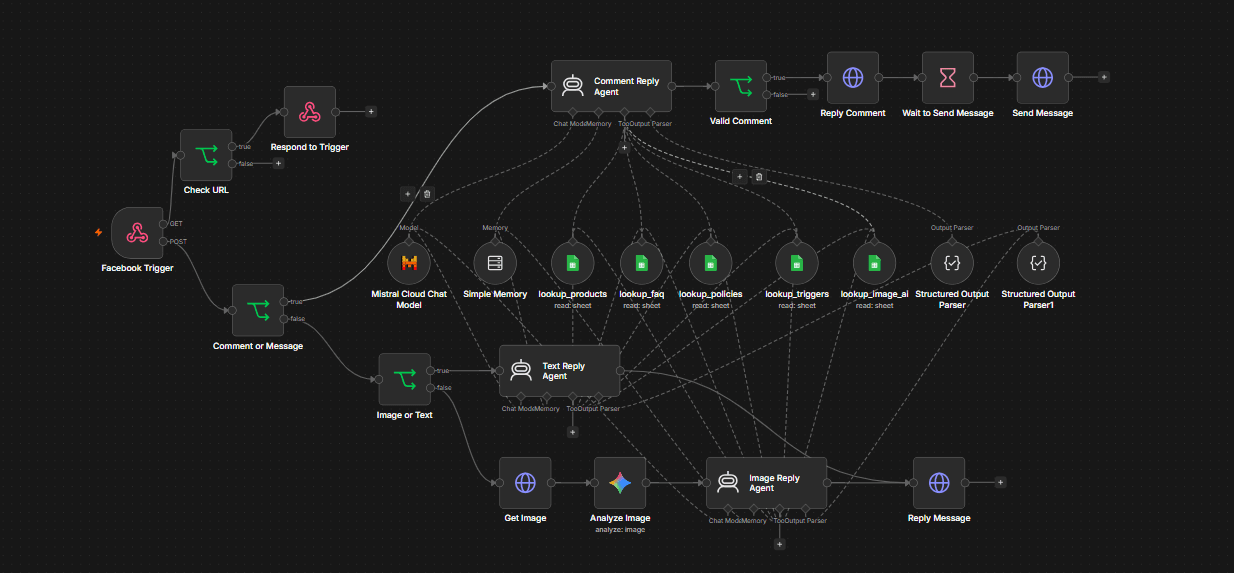
An AI agent that watches your Facebook posts & ads, replies to comments, answers DMs, and closes sales in Messenger — while you sleep. ## The Problem When a business runs a Facebook post or an ad campaign, the comments start coming in fast. People ask about price, availability, delivery, features — and they expect a reply within minutes. Not hours. But most business owners can't sit in front of their screen all day. And hiring someone just to reply to Facebook comments is expensive and still not fast enough. So leads wait. Some of them lose interest and buy from a competitor. Sales that could have been closed in 10 minutes turn into lost opportunities. I saw this problem and built something that handles the entire conversation — from the first comment to the final sale — without the business owner touching anything. --- ## What It Does The moment someone comments on a Facebook post or a running ad, the AI agent jumps in. It reads the comment, understands what the person is asking, and posts a relevant, personalized reply right there in the comment section. But it doesn't stop there. It also opens a **Messenger conversation** with that same person and starts a proper chat — greeting them, answering their questions about the product or service using the actual business information and campaign details, and guiding them toward making a purchase. The AI isn't giving generic answers. It's pulling from the business database, so it knows the product, the pricing, the offers, and the common questions — and it responds like a trained sales rep would. When a sale is closed inside Messenger, the agent automatically **updates the sales record in Google Sheets** and sends the business owner a **notification** so they always know what's happening without having to check manually. --- ## The Result A business can now run a Facebook campaign and go about their day knowing every single comment is getting a reply, every interested person is getting a proper conversation, and every sale is being recorded — all automatically. The response time goes from hours to **seconds.** Leads don't go cold. Sales don't fall through the cracks. And the business owner's time is freed up completely for things that actually need their attention. --- ## The Stack Built with **n8n** for the automation backbone, connected to the **Facebook Graph API** for comment and Messenger handling, **AI language model** for understanding and generating responses, and **Google Sheets** as the sales database with instant notifications to the owner. --- ## Who This Is For If you're running Facebook ads or managing a business page and you're tired of losing leads just because you couldn't reply fast enough — this is exactly what you need. It doesn't replace your brand voice, it *becomes* your brand voice, available 24/7. --- *I built with n8n · Facebook Graph API · AI Language Model · Google Sheets*
N8NGeminiFacebook API
View
AI Automation
AI-Powered SEO Lead Audit & Personalized Email Automation
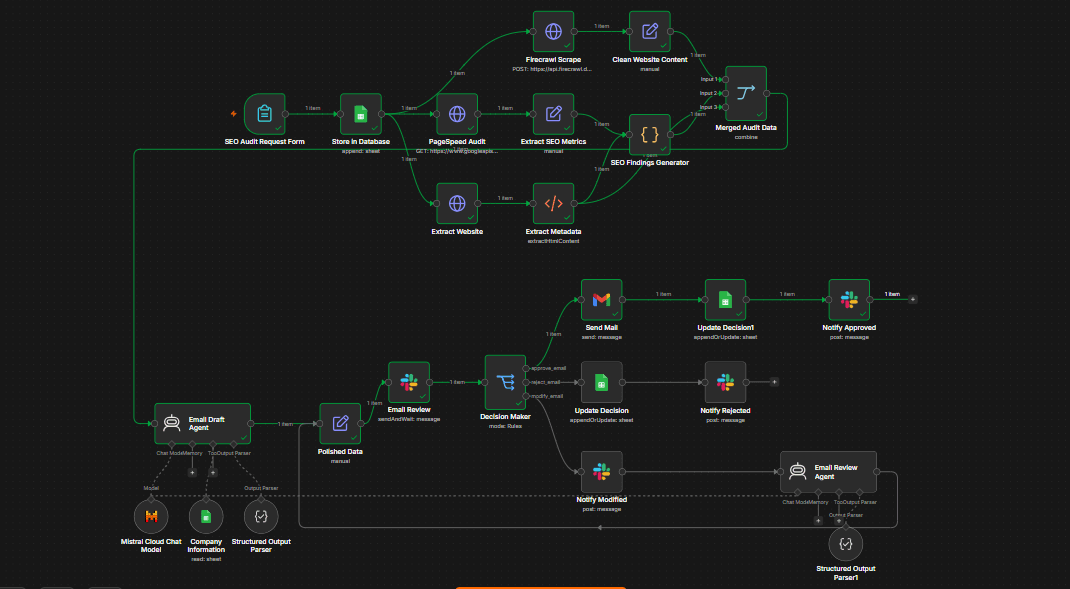
I built fully automated SEO audit system that analyzes any lead's website, generates a personalized outreach email, and gets it approved without manual research. ## The Solution I Built I designed and built a **fully automated, AI-driven pipeline** using **n8n** that takes a lead's basic information and handles everything — from deep website analysis to a human-reviewed, personalized email — completely on autopilot. Here's how it works from start to finish: --- ### 🔍 Phase 1 — SEO Lead Audit The moment a lead's details (Company Name, Website URL, Owner Name, and Email) are submitted through a form, the system kicks into gear simultaneously on three fronts: - **Firecrawl** scrapes the entire website and cleans the raw content for analysis - **Google PageSpeed API** runs a full performance audit - **Metadata Extractor** pulls all on-page SEO signals — titles, descriptions, heading structure, and more All three data streams are merged into a single **Unified SEO Report** by an AI findings generator. What used to take a human analyst 2–3 hours now takes the system **under 3 minutes.** The lead's data and report are also saved to a **Google Sheets database** automatically, so nothing ever slips through the cracks. --- ### ✉️ Phase 2 — AI Email Drafting Once the SEO report is ready, it goes straight to an **AI Email Draft Agent** (powered by **Mistral AI**). This agent doesn't send a generic template. It reads the actual SEO findings, combines them with the company information, and writes a **genuinely personalized outreach email** — one that highlights the specific problems found on *that* lead's website and positions your agency as the solution. The difference is night and day compared to a copy-paste cold email. --- ### 👨💼 Phase 3 — Human Review & Approval via Slack The drafted email is sent directly to the **Senior SEO Consultant's Slack** for review. From there, the consultant has three choices: **✅ Approve** — The email is sent to the lead immediately via Gmail. The database is updated with the client's report and status, and the team gets a Slack notification confirming delivery. **❌ Reject** — The lead is marked as rejected in the database, and the team is notified via Slack. No wasted sending. **✏️ Modify** — The consultant writes their revision notes directly in Slack. A second **AI Email Review Agent** picks up those instructions, rewrites the email accordingly, and sends it back to the Draft Agent — which then pushes the revised version back to Slack for another review round. This **approval loop runs as many times as needed** until the consultant is satisfied. No back-and-forth over email threads. No chasing people on WhatsApp. Everything happens inside Slack. --- ## The Stack Behind It | Tool | Role | |---|---| | **n8n** | Workflow automation backbone | | **Mistral AI** | Email drafting & revision agent | | **Firecrawl** | Full website scraping | | **Google PageSpeed API** | Performance audit | | **Google Sheets** | Lead & report database | | **Gmail** | Automated email delivery | | **Slack** | Review, approval & team notifications | --- ## The Real Impact This system doesn't just save time — it changes **how an SEO agency can scale.** - ⚡ **Lead audit time cut from 3–5 hours to under 3 minutes** - 📈 **10x more leads can be processed per day** with the same team size - 💬 **Personalized emails** — not templates — improve reply rates - ✅ **Senior consultant stays in control** without being buried in manual work - 🗂️ **Every lead, report, and status is tracked automatically** in one database - 🔁 **Revision loop keeps quality high** while still being fully managed in Slack For an SEO agency sending even 20 outreach emails a week, this system can recover **40–100 hours of labor per month** — hours that can now go toward actual client work and revenue. --- ## Why This Matters Most agencies know they need to do more outreach. They know personalization works. They know their senior consultants shouldn't be spending half their day on admin. But building the bridge between *knowing* and *doing* is hard. This system is that bridge. It's not about replacing the human — the consultant still reads every email and makes the final call. It's about removing all the grunt work so that human judgment can go where it actually matters. If you're an SEO agency, a digital marketing firm, or any team that does lead-based outreach, **this kind of automation is no longer a luxury. It's a competitive advantage.**
N8NSlackEmail
View