Why Most AI Agents Never Make It to Production (And What Actually Works)
S
Syful Islam
July 1, 2026
Category:
AI Automation
Tags:
#aiagents
#production-engineering
#n8n
#langchain
#rag
#automation
Last month, a client came to me with a problem that sounded familiar. They'd spent three months building an AI customer service agent. It worked beautifully in the demo — handled questions, pulled from their knowledge base, even sounded human. Then they turned it on for real customers.
Within a week, it had:
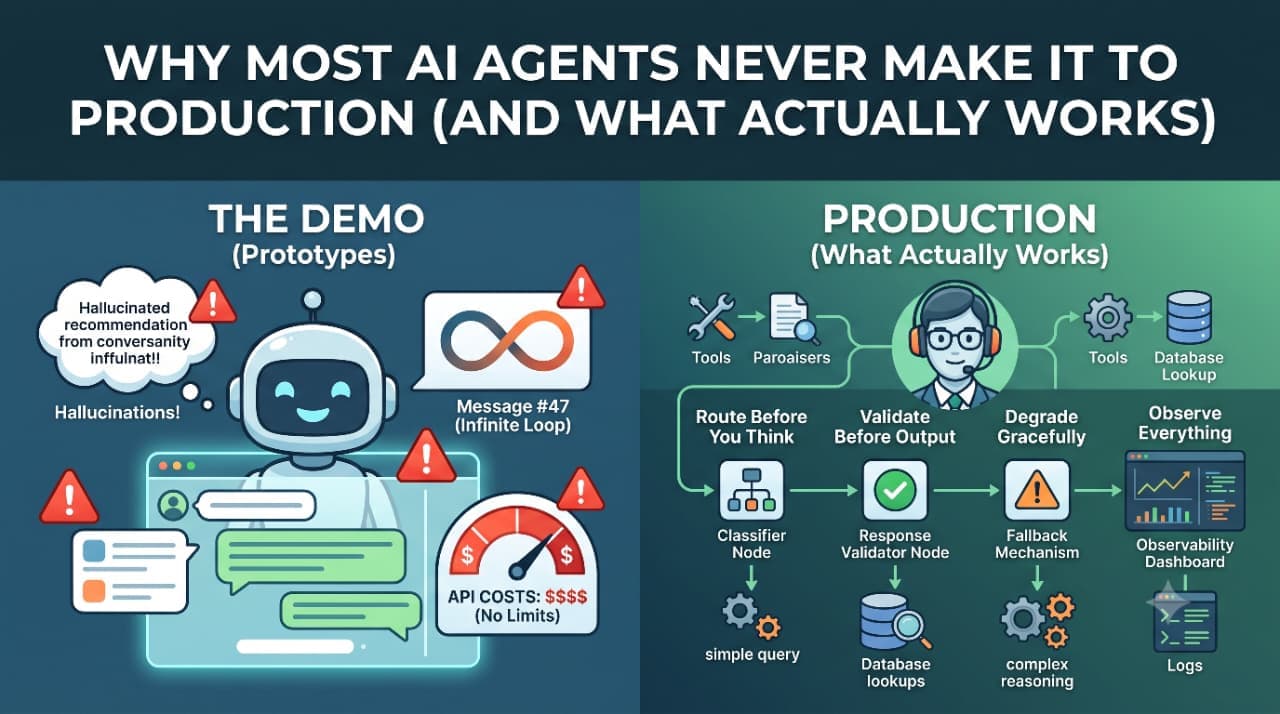
Recommended a competitor's product (hallucination from an old knowledge base entry)
Sent 47 messages to the same customer (infinite loop in the retry logic)
Cost them $340 in API calls in a single weekend (no rate limiting)
I've been building AI agents for the past two years — from my AI Receptionist (n8n + Telegram + Calendar + RAG) to a full AI Sales Agent pipeline. I've failed enough times to see the pattern. And the pattern is this: the gap between a working demo and a production-ready agent is wider than most people think.
According to a 2025 study by LangChain, nearly 70% of AI agent projects never make it past the proof-of-stage phase. Not because the models aren't good enough — but because production engineering for agents is a fundamentally different problem than building a demo.
Let me show you what actually breaks, and how to fix it.
The 3 Reasons AI Agents Die in Production
After building agents with n8n workflows, LangChain pipelines, and custom FastAPI backends, I've narrowed the failure modes down to three core problems. Miss any one of them, and your agent will eventually fail.
1. State Management Is an Afterthought
In a demo, state is easy. The user asks a question, the agent answers, done. But production agents have to handle:
Multi-turn conversations that span hours or days
Partial failures (API goes down mid-conversation)
Concurrent users with different context windows
Tool calls that timeout or return unexpected formats
I learned this the hard way with my AI Sales Agent. The n8n workflow would sometimes lose context between the Facebook webhook trigger and the AI response node. The agent would answer the previous message because the conversation state wasn't properly scoped per thread.
The fix: Explicit state machines. Don't rely on the model to "remember" — build a deterministic state layer. Here's the pattern I use now:
This seems obvious in writing, but I've reviewed at least a dozen agent projects that skip it. They trust the LLM to manage context implicitly. That works in demos. It fails in production.
2. Error Handling Is Modeled for Happy Paths
Here's what nobody tells you about production agents: your tools will fail at the worst possible time.
APIs timeout. Webhooks deliver malformed payloads. The knowledge base returns irrelevant results. The model outputs JSON with a trailing comma. And when any of these happens, your agent doesn't just fail — it fails silently and keeps going with corrupted state.
The Haystack framework (25.7k stars on GitHub, just released v2.30) has a concept they call "transparent pipelines" — the idea that you should be able to inspect every decision your agent makes. This is what production error handling looks like:
Every tool call gets wrapped in a try/except with structured error logging
Failed tool calls trigger a fallback strategy (not just "try again")
The agent knows what it doesn't know and escalates accordingly
I now build every agent with what I call an "error budget" — if more than 3 tool calls fail in a single session, the agent automatically escalates to a human. This single pattern has saved more of my agents than any prompt engineering trick.
3. Cost and Latency Are Designed, Not Optimized
The OpenAI custom chip announcement from yesterday (June 24, 2026) is telling. OpenAI — the company with the most compute resources on the planet — is investing in custom silicon specifically to reduce inference costs. If they're worried about the economics of running agents at scale, you should be too.
Here's the math that kills most agent projects:
Average agent makes 3-5 tool calls per user message
Each tool call requires at least 1 API call (often 2-3 with RAG)
At $0.01-0.05 per 1K tokens (depending on model), a 10-turn conversation costs $0.10-0.50
1,000 daily users × $0.30 = $90/day just for inference
And that's before you factor in vector database hosting, monitoring infrastructure, and the engineering time spent debugging edge cases.
The fixes that actually work:
Model routing: Use cheap models (GPT-4o-mini, Mistral) for classification and routing decisions. Reserve expensive models only for generation and complex reasoning.
Aggressive caching: Cache tool results, knowledge base lookups, and even full responses for common queries. My AI Receptionist caches 60% of its responses.
Async processing: Not every agent action needs to be synchronous. Queue non-critical tasks (logging, analytics, follow-up emails) for background processing.
The Production Agent Architecture That Actually Works
After iterating through enough failures, here's the architecture I've settled on. It's not the simplest, but it's the one that survives contact with real users.
User Input → State Manager → Router (cheap model)
                                ↓
                    ┌───────────┼───────────┐
                    ↓           ↓           ↓
              Simple Query   Tool Call   Complex Reasoning
              (cache/FAQ)    (agent)     (expensive model)
                    ↓           ↓           ↓
                    └───────────┼───────────┘
                                ↓
                         Response Validator
                                ↓
                          Output to User
Key principles:
Route before you think. Don't send every query to a powerful model. Classify intent first, then route to the appropriate handler. This alone can cut costs by 70%.
Validate before output. Every agent response passes through a validator that checks for: hallucinations (against your knowledge base), tone consistency, and whether the response actually addresses the user's intent.
Degrade gracefully. When a tool fails, the agent should have a fallback plan — not just an error message. "I couldn't check your calendar, but here's what I can do..." beats "An error occurred."
Observe everything. Log every decision, every tool call, every token consumed. You can't debug what you can't see. This is why I love n8n's execution history — every node shows you exactly what happened.
What I'd Do Differently (Lessons from the Trenches)
If I could go back to my first AI agent project, here's what I'd change:
Start with the error cases, not the happy path. I spent 80% of my time on the core workflow and 20% on error handling. It should have been the opposite. In production, your agent spends more time handling edge cases than doing the "main thing."
Use frameworks that embrace production reality.Haystack (25.7k stars) is designed for this — pipelines are serializable, components are swappable, and there's built-in observability. n8n (194k stars) gives you visual debugging and 400+ integrations out of the box. I've moved away from hand-rolled LangChain for anything beyond prototypes.
Build for observability from day one. Not as a feature you add later. Every agent decision should be traceable. When a client asks "why did the agent say that?", you should be able to answer in under 30 seconds.
Test with adversarial inputs. Your users will be confused, angry, and will type things that make no sense. Test for that. The peerd agent that recently trended on Hacker News has an interesting approach here — it runs in a sandboxed browser environment with two layers of prompt injection protection. That's the kind of defensive thinking production agents need.
Your Action Plan for This Week
If you have an agent in development or planning, here's what I'd focus on this week:
Audit your state management. Can you answer "what is the agent doing right now?" at any point? If not, add explicit state tracking.
Add an error budget. After 3 consecutive tool failures, escalate to a human. This single rule prevents most catastrophic agent failures.
Implement model routing. Separate your "thinking" calls from your "classification" calls. Use cheap models for the latter.
Set a cost ceiling. Decide what you're willing to pay per interaction, then build alerts when you approach it.
Test the worst case. Give your agent the most confusing, ambiguous, off-topic input you can imagine. Does it handle it gracefully, or does it spiral?
Building AI agents that work in production isn't about having the best model. It's about having the best engineering around the model. The good news? Once you nail the architecture, you can focus on what actually matters — solving real problems for real users.
That's what keeps me building. Every failed agent teaches me something, and every successful one saves someone's business hours they'll never get back. That's worth the engineering overhead.
Big AI labs are hiring philosophers — Hacker News discussion, June 2026. Highlights the industry trend of prioritizing reasoning and philosophical thinking in AI development.